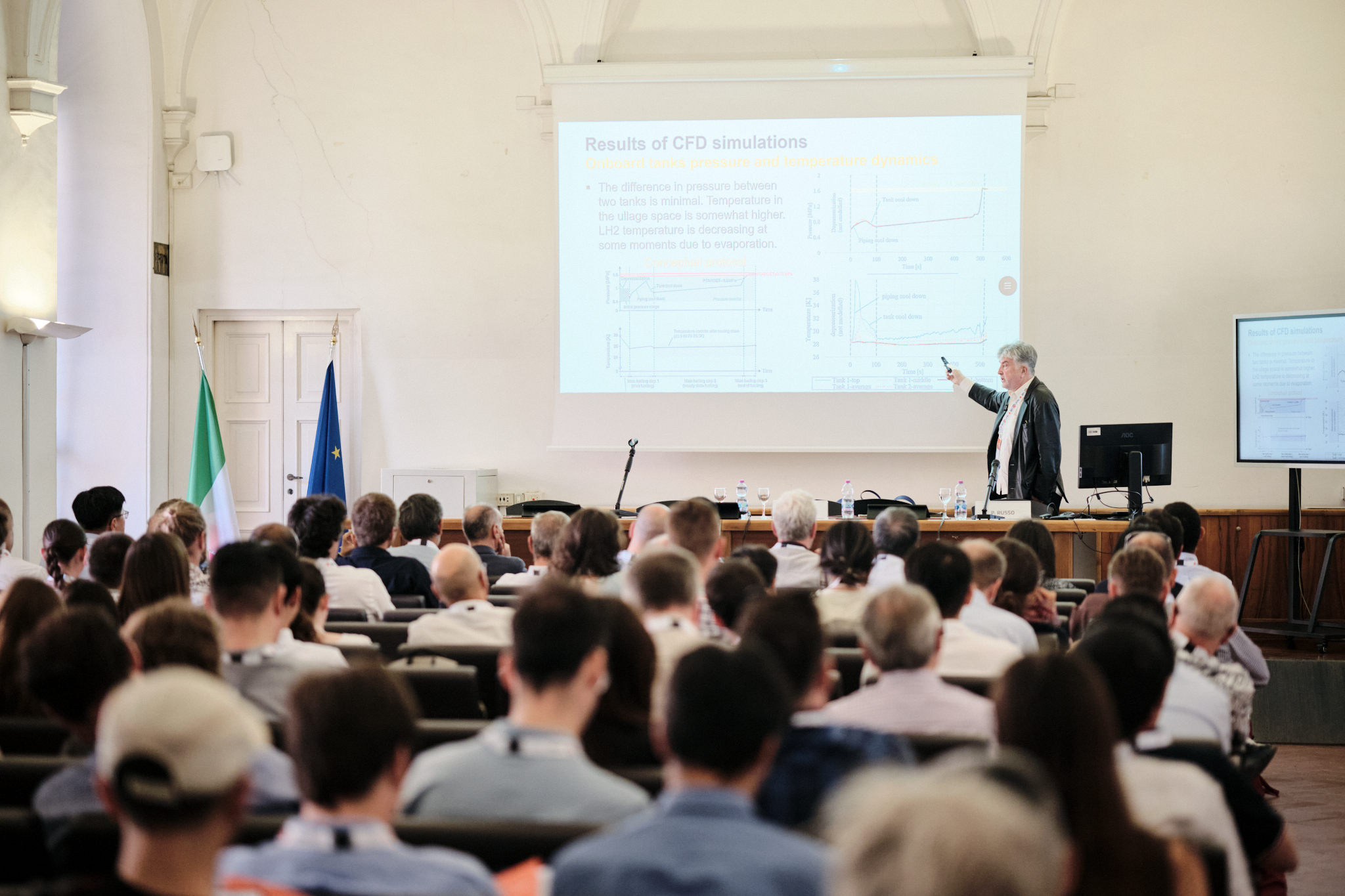
Representing the Clean Maritime Research Hub, Professor Vladimir Molkov and Dr. Sergii Kashkarov from Ulster University contributed to the international dialogue. Professor Molkov delivered a plenary lecture on the opening day titled ‘Progress in Computational Hydrogen Safety: Overview of Selected Problems’, highlighting recent advancements and ongoing challenges in the field.
Additional presentations/ submissions from colleagues included:
Sivaraman S, Cirrone D, Makarov D, Benjamin Truchot, Molkov V. Numerical modelling of dynamic flashing behaviour in the release of ammonia from pressurised vessel.
Cirrone D, Makarov D, Molkov V. Numerical investigation on the pressure multipeaks structure of a LH2 storage tank “BLEVE”.
Kashkarov S, Makarov D, Molkov V. Performance of conformable hydrogen tanks in a fire test and a road fire incident.
Kazemi M, Brennan S, Molkov V. Critical diameter and flame stability in hydrogen-methane mixtures.
Ebne-Abbasi H, Makarov D, Molkov V. Numerical simulations of sLH2 refuelling: impact of initial mass flow rate on HRS process dynamics.
The Ulster team also received a prize for best paper, awarded to Dr Donatella Cirrone for the paper titled ‘Numerical Investigation on the Pressure Multi-Peaks Structure of a LH2 Storage Tank “BLEVE”’.
For further information on hydrogen safety please see:
Summary: Exhaust gas fuel reforming is a process that uses the heat from engine exhaust to help break down fuel or ammonia into a hydrogen-rich gas. This gas burns better than regular fuel, which makes engines more efficient and cleaner. In engines that run on ammonia, this process also helps burn the ammonia more effectively and reduces emissions of any unspent ammonia from
the exhaust (i.e. ammonia slip).
This seminar provided an overview of:
Ammonia cracking with heat recovery
Exhaust gas fuel reforming
Case studies of catalytic reactors
Engine performance and emissions
Environmental catalysis
2. Out of the tank into the air: Ammonia dispersion
Summary: There are complex changes that occur when liquid ammonia is released from a pressurised storage tank. These changes occur not only for the released ammonia but also the conditions in the storage tank.
During release from a pressurised tank, liquid ammonia boils due to pressure drop and becomes a gas. Toxic gaseous ammonia is easily dispersed in the atmosphere. The hazard distance depends on a wind conditions. Understanding the complex underlying physical phenomena, including dispersion in meandering wind, is important for inherently safer use of ammonia as a fuel.
This seminar provided an overview of the numerical experiments performed using a contemporary tool developed by Prof. Molkov and his team to understand the phenomenon and validate against large-scale experiments performed by INERIS in France.
It was found that the model was able to reliably predict:
The amount of released ammonia,
It’s concentration at different distances in realistic wind conditions
The resulting final pressure in the tank.
The model is able to define hazard distance (both flammability and toxicity) through dispersion. The model can be used as a contemporary tool for safety engineering, hazards and associated
risk assessment, and developing tank management safety strategies for liquid ammonia storage. The model will be further validated against the bunkering and debunkering of ammonia
experimental data when it becomes available.
Summary: Persistent bottlenecks at ports have significantly disrupted global supply chains, necessitating more efficient seaport operations to address yard density and port congestion. An untapped but potentially critical approach to mitigating these challenges is to leverage container characteristics, road traffic data and machine learning to optimise container storage strategy
and ferry scheduling.
An empirical study conducted at a container seaport shows that our framework yields cost savings ranging from c.15-30% compared to the Business-as-Usual scenario. Additionally, the road traffic prediction for ferries yields an accuracy of over 75%.
4. Port Decarbonisation: Emissions, measures and studies
Summary: Professor Song presented the emission sources at seaports and categorised them based on criteria such as geographic location and emission scope. Subsequently, he discussed emission reduction measures at seaports, organizing them into six structured categories:
Operational measures
Technical measures
Fuel and energy measures
Infrastructural measures
Digitalization measures
Policy and collaboration measures
A time-phased roadmap outlining mitigation strategies for port decarbonization on the path to net zero was presented, concluding with an overview of several case studies that demonstrate the application of specific emission reduction measures.
5. Wind-assisted ship propulsion: Status, challenges and the future
Summary: Maritime transportation accounts for 90% of the world’s trade and is responsible for 3% of global energy-related carbon dioxide emissions. With ever-more stringent emission regulations, such as that of the International Maritime Organisation (IMO), there is a vital and urgent need to decarbonise shipping.
While operational measures and alternative fuels are proving suitable short-term solutions to meet these novel regulatory constraints, as the use of fossil fuels tapers off, wind-assisted ship
propulsion has emerged as a long-term solution, with a range of technologies available. These include soft sails, rigid wings, rotors, kites and many more.
This talk presented the state of the art in wind-assisted ship propulsion, including technologies, emission reduction potential, current and future vessels, and related research, such as routing algorithms. Further, the recent developments, challenges and future perspectives were discussed to provide a holistic view of wind-assisted ship propulsion.
We’d like to extend our sincere thanks to everyone who attended the Clean Maritime Assembly 2025. It was fantastic to see such strong engagement from both industry professionals and academic experts. The event was filled with vibrant discussions, valuable insights, and a real sense of shared purpose. Your contributions helped create an inspiring atmosphere, and we’re grateful for the energy and enthusiasm you brought to the day.
A particular highlight of the 2 days were the poster presentations, which showcased some impressive research being done to decarbonise the maritime sector. These displays not only allowed attendees to engage with cutting-edge research and innovation, but also provided researchers—especially early-career participants—with a valuable opportunity to enhance their presentation and communication skills. The breadth and depth of work on display reflected the sector’s commitment to a cleaner maritime future. We’d like to thank all entrants for their contributions and are delighted to announce the winners, as voted by you!
On Day 1 of the Assembly, the day was captured in photos, to produce a photo mosaic. If you were there, take a look and see if you can spot yourself or your colleagues. It’s a great snapshot of the energy and collaboration that defined the day.
Thanks again for being part of the Clean Maritime Assembly and for your valuable feedback which will help shape future events. Watch this space as we add the presentations from the Assembly to our Resources library!
To provide the best experiences, we use technologies like cookies to store and/or access device information. Consenting to these technologies will allow us to process data such as browsing behavior or unique IDs on this site. Not consenting or withdrawing consent, may adversely affect certain features and functions.
Functional
Always active
The technical storage or access is strictly necessary for the legitimate purpose of enabling the use of a specific service explicitly requested by the subscriber or user, or for the sole purpose of carrying out the transmission of a communication over an electronic communications network.
Preferences
The technical storage or access is necessary for the legitimate purpose of storing preferences that are not requested by the subscriber or user.
Statistics
The technical storage or access that is used exclusively for statistical purposes.The technical storage or access that is used exclusively for anonymous statistical purposes. Without a subpoena, voluntary compliance on the part of your Internet Service Provider, or additional records from a third party, information stored or retrieved for this purpose alone cannot usually be used to identify you.
Marketing
The technical storage or access is required to create user profiles to send advertising, or to track the user on a website or across several websites for similar marketing purposes.