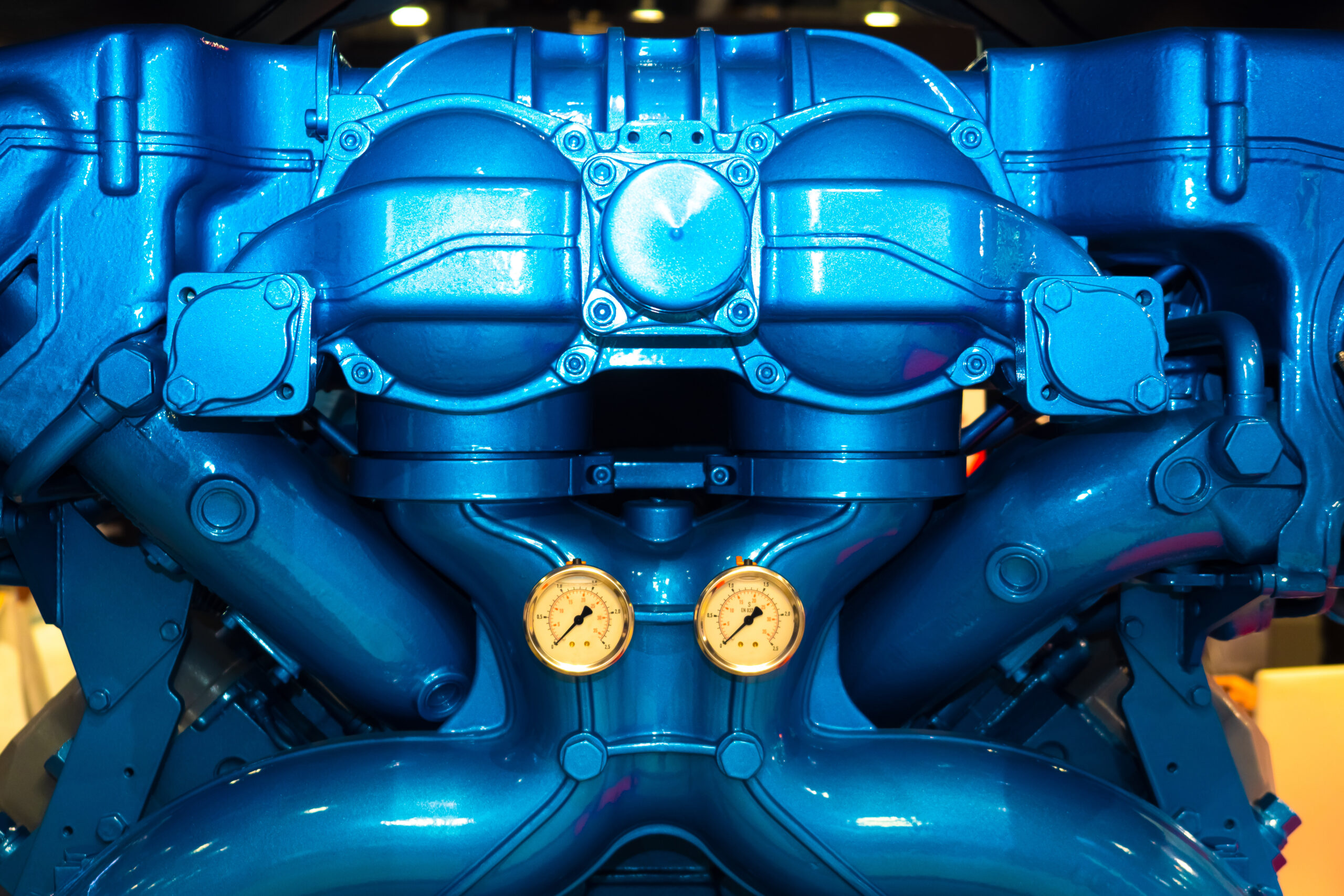
A CFD study on ammonia combustion and performance of a dual-fuel marine engine
“Abstract
Ammonia-fuelled engines have primarily targeted light-duty automotive internal combustion engines. However, ammonia can be a potential carbon-free fuel for large-bore marine engines to decarbonise the maritime sector. In this study, a CFD model was developed and validated to assess direct ammonia injection in a large-bore marine engine. The impacts of liquid ammonia energy ratios up to 77% and injection timings on combustion, engine performance, and emissions were examined. The results showed that the highest indicated thermal efficiency of 48.3% was achieved at SOINH3 − 40 CAD, where the main combustion occurred at TDC and overlapped with diesel ignition, leading to a shorter combustion duration. Varying ammonia injection timing revealed that the minimum NH3 slip of 4.1 g/kWh was at SOI − 40 CAD and increased for both earlier and later ammonia injection timings. Liquid ammonia significantly reduced NOX emissions from 7.7 g/kWh in the diesel case to just 1.3 g/kWh due to lower combustion temperature. Moreover, advancing ammonia SOINH3 from − 15 to − 50 CAD significantly reduced CO emissions from 9.1 to 2.7 g/kWh. The results also showed that N2O primarily forms in thin mid-temperature NH3-rich layers ahead of the flame front, and earlier ammonia injection expands these zones, increasing N2O emissions.”
Nadimi, E., Zhang, Y., Wu, D. and Przybyla, G. (2027). A CFD study on ammonia combustion and performance of a dual-fuel marine engine. Fuel, 427, p.139951. doi:10.1016/j.fuel.2026.139951.
The full article is accessible via:
https://doi.org/10.1016/j.fuel.2026.139951
For related publications please see Resources – UK National Clean Maritime Research Hub