Reflecting on the Clean Maritime Assembly 2026
The Clean Maritime Assembly 2026 brought together stakeholders from academia, industry, and government to explore the challenges and opportunities surrounding maritime decarbonisation. Feedback from both days indicates that the event successfully achieved its core objective: convening the sector, fostering collaboration, and enabling meaningful discussion.
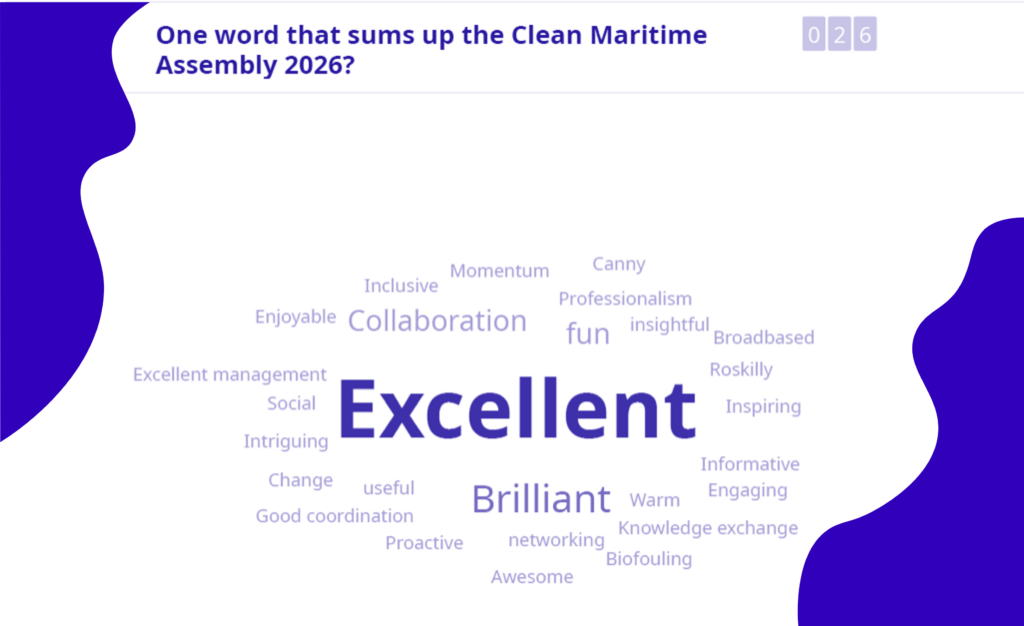
Participants consistently highlighted the value of connecting with peers, exchanging ideas, and gaining insight from a wide range of perspectives. Networking and knowledge sharing were widely regarded as the most impactful aspects of the Assembly.
A clear narrative emerged throughout the event. While innovation across the sector is strong, progress continues to be constrained by several systemic barriers, including policy uncertainty, limited investment, infrastructure challenges, and fuel availability. At the same time, there is growing alignment across the maritime community and a shared willingness to drive change.
Feedback from Day 2 suggested that discussions had begun to translate into tangible outcomes. Participants reported identifying new collaborations, partnerships, and opportunities that arose directly from the connections made during the event.
Overall, the Assembly provided a valuable platform for collaboration, alignment, and action. It not only facilitated the development of new relationships and opportunities but also clearly highlighted the key challenges that must be addressed to accelerate maritime decarbonisation.
Presentations
We want to extend our thanks to all presenters and keynotes who contributed to the Clean Maritime Assembly 2026!
Presentations will be made available for download from our Resources Library in due course. Due to the huge range of speakers the CMA26 spotlighted, each speaker and presentation title will be listed in the resource posts.
🏆Poster Competition Winners🏆
First place:
- Paul Simavari, Newcastle University: Reconstructing Vessel Energy Demand From Sparse Publicly Available Data
Joint second place:
- Mohammadhossein Shamsaddinsaeid, Ulster University: Numerical study of LH2 release and dispersion from the bottom of a 56 m³ vertical storage tank in a port area: hazard distances based on flammability and frostbite
- Ruiqi Wang, Durham University: Towards Sustainable Port Infrastructure: A Life Cycle Perspective on EV-Charging-Integrated HVAC Systems
Third place:
- Shadab Alam, Net Zero Industry Innovation Centre (NZIIC), Teesside University: Towards Greener Shipping: Feasibility of Methanol Reforming, CO₂ Capture and Port-Side CO₂ Utilisation for UK Maritime Corridors